1. Model
This page provides a series of tutorials on nanotube, graphene, and magic graphene modeling.
1.1 Structural information of the model
Both nanotubes and magic-angle graphene are built from single-layer graphene, and they have the same definition of chirality (n, m).
Graphene
Total number of atoms(N):
where g1 is the greatest common divisor of n+2m and 2n+m, and p is the period.
Magic-angle graphene
Total number of atoms(N):
Magic angle(𝜃):
Nanotube
Total number of atoms(N):
Diameter(d):
where b is the atomic bond length.
Total length(l):
Chirality angle(𝜃):
[1] E.J. Mele, Interlayer coupling in rotationally faulted multilayer graphenes, J Phys D Appl Phys 45 (15) (2012).
[2] P. Moon, M. Koshino, Optical absorption in twisted bilayer graphene, Phys. Rev. B 87 (20) (2013).
[3] S. Shallcross, S. Sharma, E. Kandelaki, O.A. Pankratov, Electronic structure of turbostratic graphene, Phys. Rev. B 81 (16) (2010).
[4] M.S. Dresselhaus, G. Dresselhaus, R. Saito, Carbon fibers based on C60 and their symmetry, Phys Rev B Condens Matter 45 (11) (1992) 6234-6242.
[5] C.T. White, D.H. Robertson, J.W. Mintmire, Helical and rotational symmetries of nanoscale graphitic tubules, Phys Rev B Condens Matter 47 (9) (1993) 5485-5488.
1.2 Graphene
Input
from pymatsci.model import Graphene        # 导入石墨烯模块
model = Graphene(10, 0, 1.42, ['C'], 4)    # 输入手性参数、键长、原子种类以及周期
model.write_vasp('./POSCAR')               # 输入存储的地址和文件名,产生vasp的输入文件
# model.write_lammps('./data.txt')         # 产生lammps的输入文件
Output
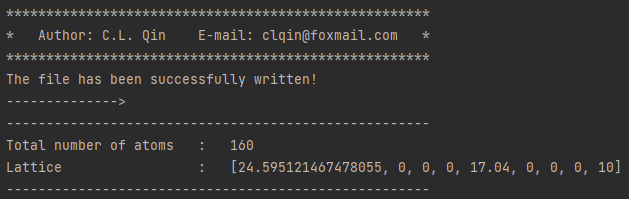
Console:
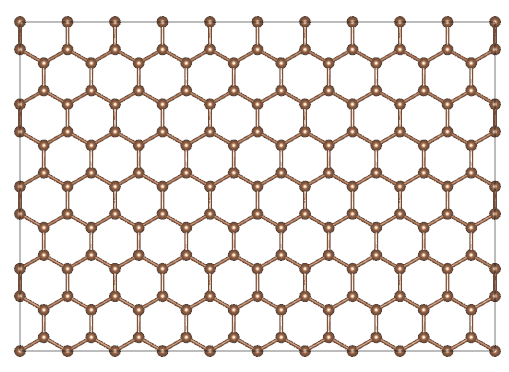
Generated model:
1.3 Magic-angle graphene
Input
from pymatsci.model import MagicGraphene         # 导入魔角石墨烯模块
model = MagicGraphene(10, 5, 1.42, ['C'], 3.4)   # 输入手性参数、键长、原子种类以及层间距
model.write_vasp('./POSCAR')
# model.write_lammps('./data.txt')
Output
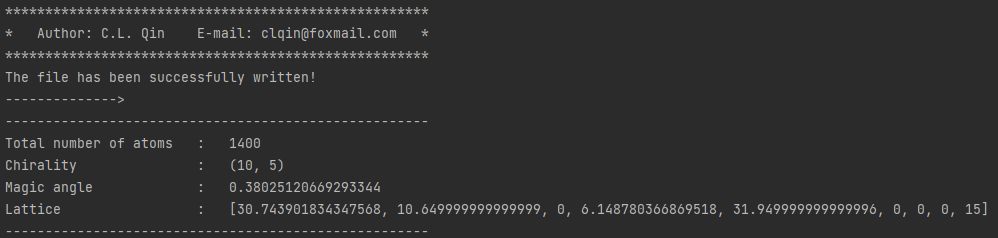
Console:
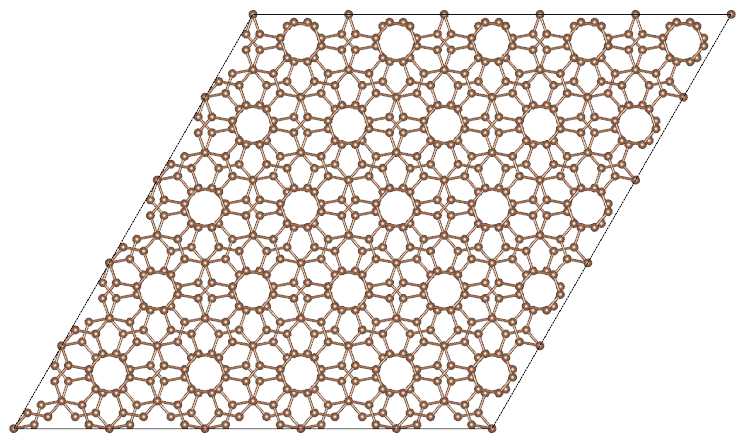
Generated model:
1.4 Nanotube
Input
from pymatsci.model import Nanotube       # 导入纳米管模块
model = Nanotube(10, 5, 1.42, ['C'], 5)   # 输入手性参数、键长、原子种类以及周期
model.write_vasp('./POSCAR')
# model.write_lammps('./data.txt')
Output
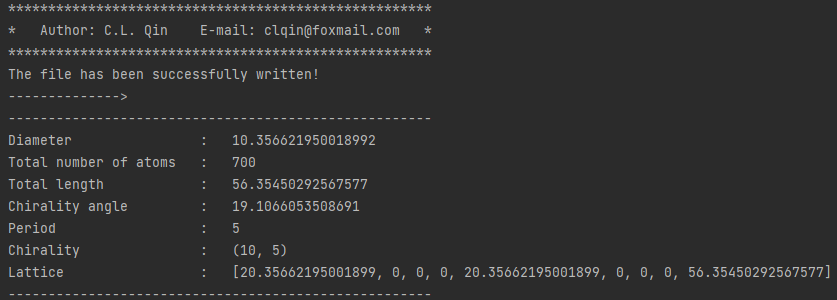
Console:
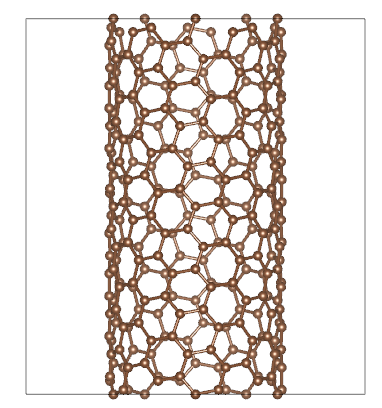
Generated model: